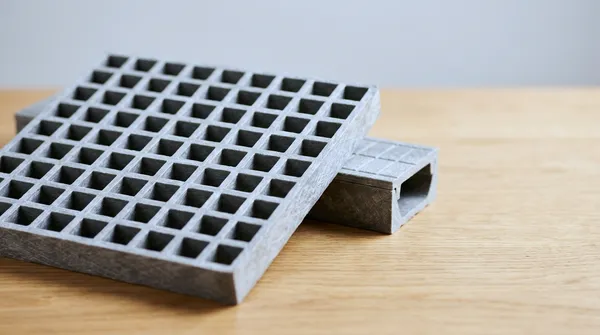
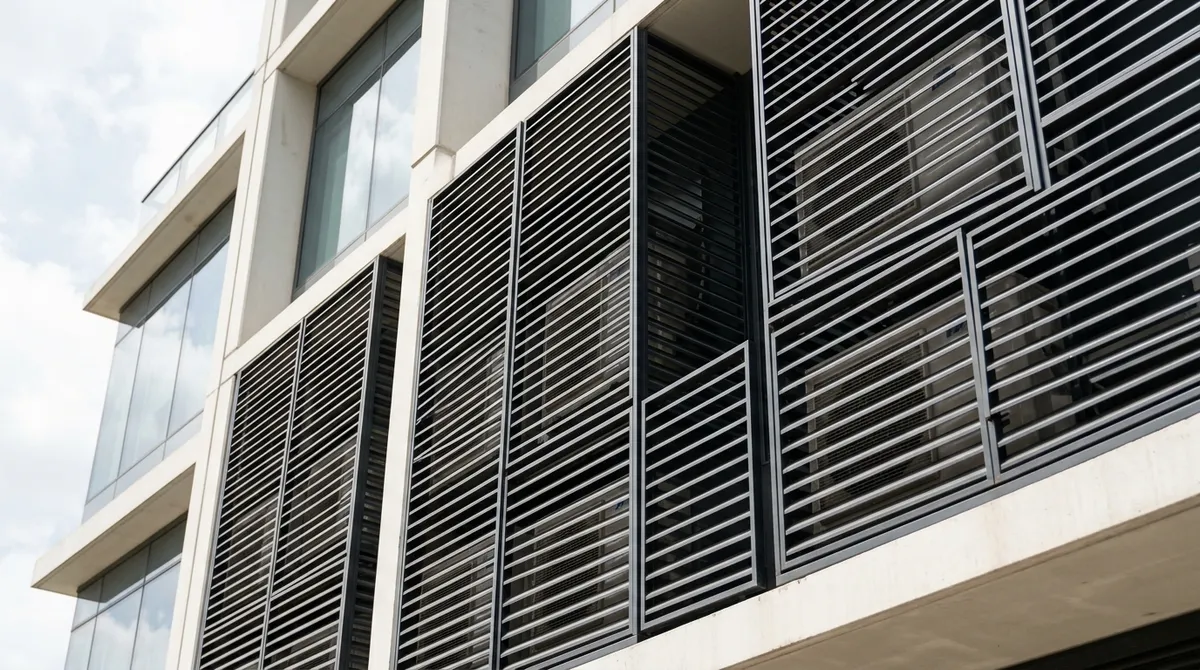
FRP grating can be used to screen air-conditioning outdoor units while preserving ventilation, organizing the facade, and reducing corrosion maintenance. A successful AC outdoor unit cover is not simply a decorative box: it must respect the equipment manufacturer’s clearance, prevent hot-air recirculation, provide service access, and remain securely anchored under local wind loads.
Why AC outdoor units overheat behind screens
An outdoor unit rejects heat through its condenser and fan. When a wall, louver, or cover blocks the discharge—or when discharged hot air returns to the intake—the condensing temperature rises and the compressor works harder. Symptoms can include reduced cooling, higher energy use, high-pressure shutdown, and shortened equipment life.
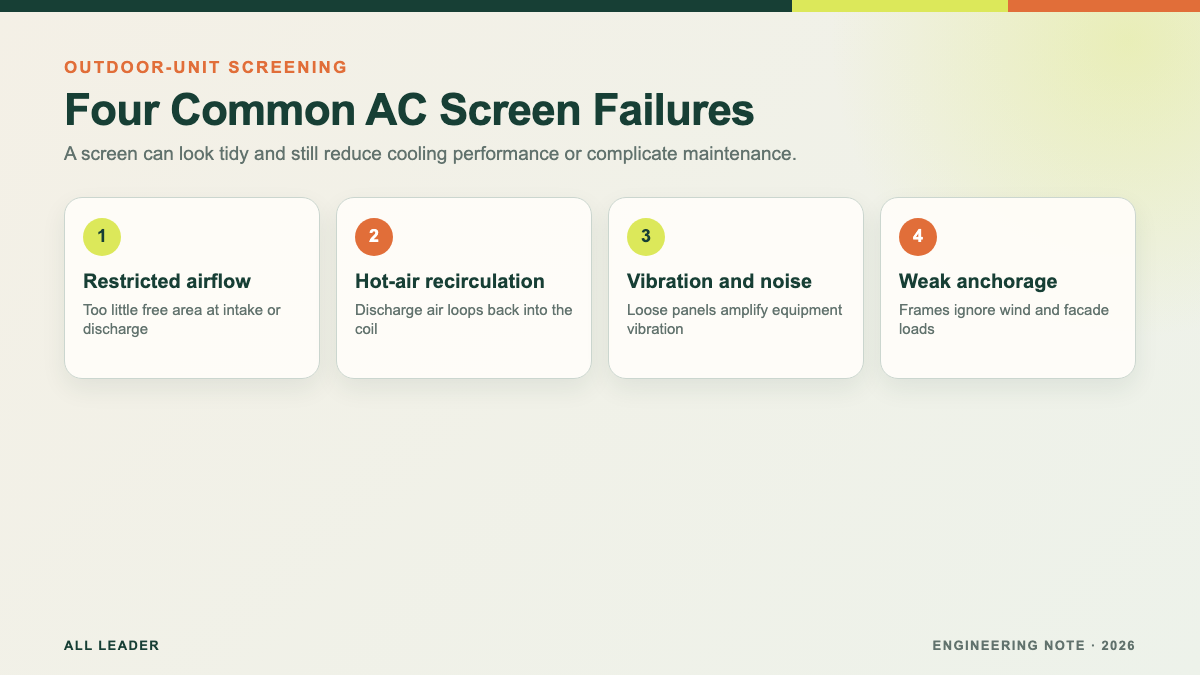
“Open-looking” does not always mean adequate ventilation. Effective free area, blade angle, depth, frame obstruction, insect mesh, adjacent walls, and the arrangement of multiple units all affect airflow. The outdoor unit manual remains the first reference; a custom screen should be checked against the actual model, not a generic clearance rule.
Why use FRP grating for an outdoor unit cover?
FRP grating is often selected in coastal, humid, rooftop, industrial, and hard-to-access locations because it does not rust like carbon steel and is lighter to handle. It can be fabricated into modular panels and frames, colored to coordinate with a facade, and supplied with open geometry that supports airflow.
The material also has low electrical conductivity in many standard formulations and is less prone to thin-sheet resonance than light metal panels. These characteristics can support safety and acoustic design, but they do not replace grounding, electrical clearances, vibration isolation, or a proper noise assessment.
FRP versus metal louvers
| Design issue | FRP grating or profiles | Galvanized steel or aluminum louvers |
|---|---|---|
| Corrosion | Does not rust; resin and UV protection must suit exposure | coating condition and galvanic compatibility require review |
| Weight | Lower handling and lifting demand | steel is heavier; aluminum is relatively light |
| Ventilation geometry | open grating can provide high free area | louver angle may reduce effective free area |
| Appearance | customizable color, panel, and profile arrangements | broad architectural finish options |
| Fire performance | resin-specific; require test data where applicable | noncombustible metal, with coating considerations |
| Maintenance | inspect connections, UV condition, and damage | inspect coating, corrosion, fasteners, and deformation |
Neither material is universally better. Metal may suit a project with specific noncombustibility or finish requirements. FRP is compelling where corrosion, lifting weight, electrical proximity, and repetitive maintenance are major concerns.
Airflow design checklist
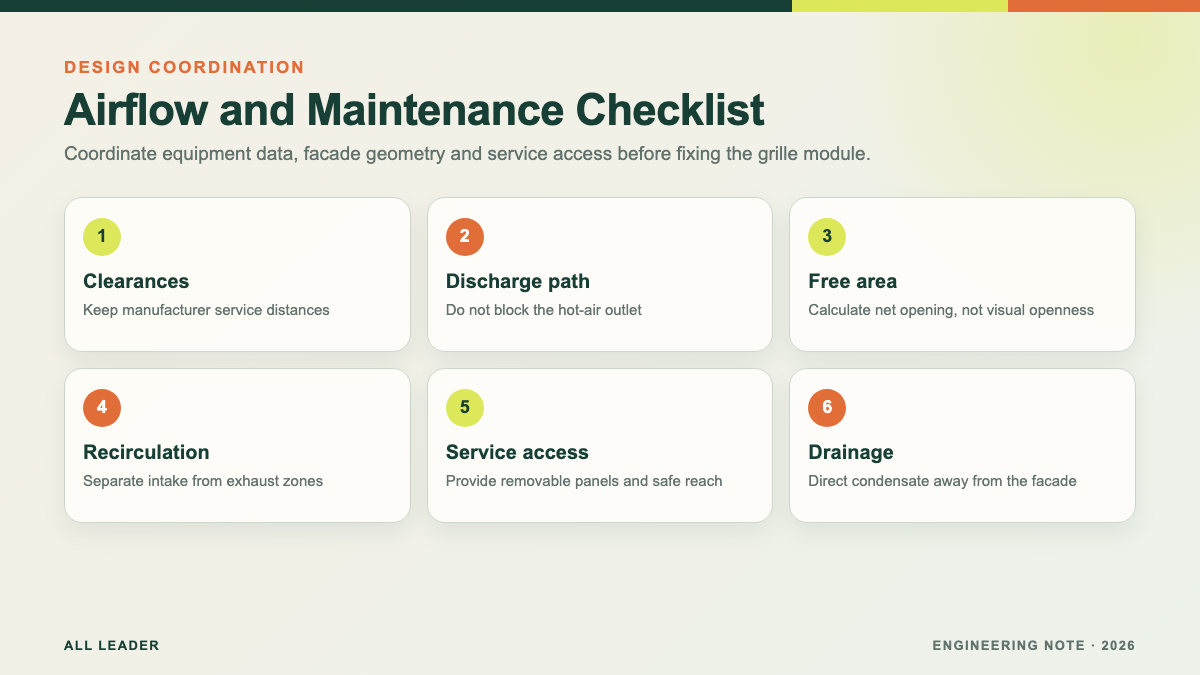
- Obtain the manufacturer’s required clearances for the exact outdoor unit model.
- Identify intake and discharge directions; do not place a dense screen directly in the discharge jet.
- Calculate effective free area, including frames, blade angle, mesh, and adjacent obstructions.
- Check hot-air recirculation for corners, balconies, shafts, stacked units, and multiple-unit banks.
- Provide makeup air and, where necessary, a discharge plenum or engineered air guide.
- Confirm that rain protection does not trap heat or direct water into electrical compartments.
- Verify performance during partial blockage from dust, leaves, or stored objects.
Computational fluid dynamics or a physical test may be appropriate for dense developments, plant rooms, or large banks of equipment. A simple free-area percentage cannot capture every flow path.
Noise and vibration
Fully enclosing an outdoor unit to reduce noise usually creates a thermal problem. Better results come from selecting quieter equipment, locating it away from sensitive windows, using resilient mounts, avoiding rigid vibration bridges, and controlling the direct sound path while keeping air passages open.
If a louver or grating produces tonal wind noise, review edge geometry, unsupported spans, panel fastening, and local air velocity. Acoustic lining may help in a designed plenum, but material must be weather-resistant, non-shedding, and kept clear of the condenser airflow.
Structure, access, and drainage
The cover and the AC unit need separate, reliable support. Anchors, frames, clips, hinges, and access panels should be designed for self-weight, maintenance loads, local wind pressure, vibration, and corrosion exposure. High-rise and coastal installations require particular attention to fixings and inspection access.
Provide a removable or hinged service panel large enough to clean coils, read the nameplate, reach valves and electrical components, and replace the unit. Condensate and rainwater must drain without dripping onto pedestrians, staining the facade, or flowing back toward the equipment.
A practical specification package
Issue coordinated drawings that show the equipment model, required clearances, grating layout, frame and anchors, support reactions, service opening, condensate route, facade interface, finish, and commissioning checks. Require material data for resin, fiber, UV and fire performance where relevant, plus load-span information and connection details.
All Leader has more than 40 years of FRP experience, over 100 customized product types, and more than 200 government-project references. Modular FRP panels are light enough to reduce lifting and site labor and can be prefabricated for faster, more predictable installation. Our team coordinates ventilation, facade, drainage, and long-term maintenance instead of treating the cover as a decorative afterthought. See our related FRP ventilation-grille application or contact us for a project review.
Frequently asked questions
Does an outdoor AC unit always need a cover?
No. A cover is useful for facade integration, access control, and environmental protection, but it should only be added when airflow, service, structure, and drainage are properly resolved.
Will an FRP screen make the AC quieter?
It may reduce some direct sound and avoids certain thin-metal resonance, but meaningful noise control usually requires equipment selection, location, vibration isolation, and acoustic design.
How much open area should the grating have?
There is no universal percentage. Use the manufacturer’s clearance and airflow requirements, then account for panel geometry, frames, mesh, wind, adjacent walls, and multiple-unit recirculation.
Can FRP grating withstand typhoons?
FRP panels can be engineered for outdoor wind loads, but capacity depends on profile, span, frame, clips, anchors, building height, terrain, and local design wind pressure. Project-specific structural verification is required.
Sources
- ASHRAE, HVAC technical resources: ashrae.org
- Air-Conditioning, Heating, and Refrigeration Institute: ahrinet.org
- American Composites Manufacturers Association: acmanet.org
- ASTM International: astm.org