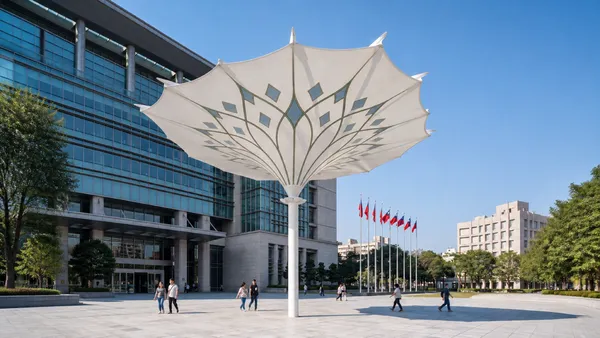
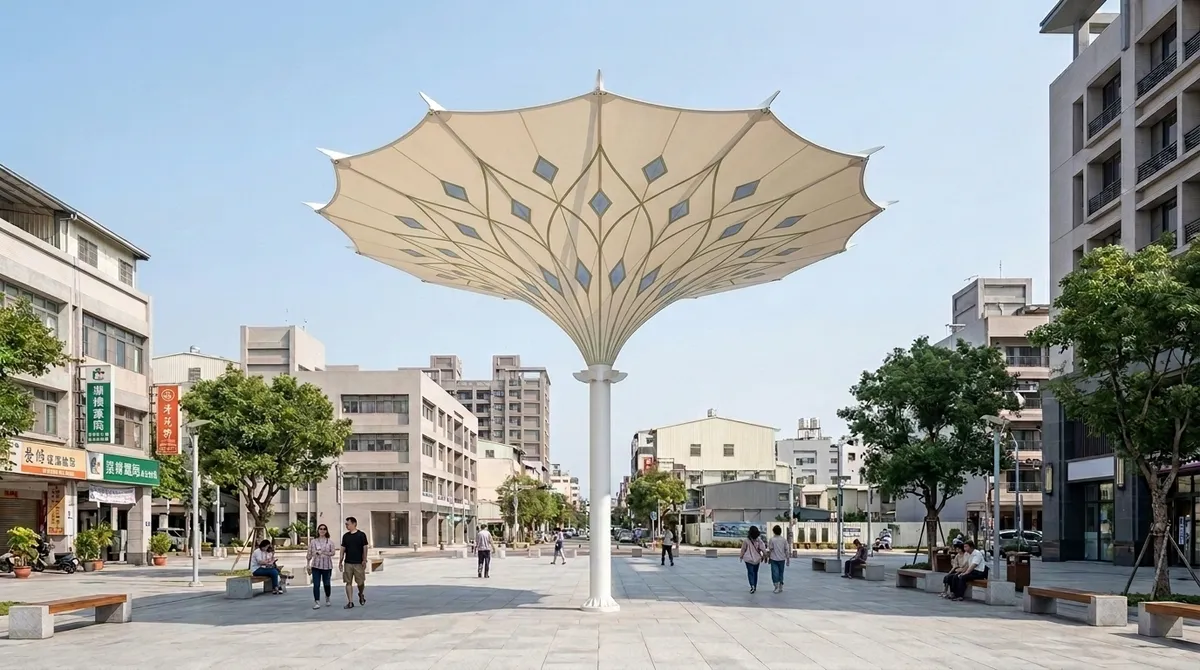
Smart shade umbrellas are permanent or semi-permanent outdoor structures that combine large-area shade with sensors, powered movement, lighting, and sometimes drainage or energy systems. For public spaces, the important word is not “smart” but “system”: the canopy, structure, controls, foundation, drainage, operating rules, and maintenance plan must work together.
What makes a shade umbrella smart?
A smart umbrella may include wind, rain, temperature, or sunlight sensors; motorized opening and closing; remote status monitoring; scheduled operation; fault alerts; and manual backup controls. Optional lighting, USB charging, solar power, or environmental monitoring can be added when they serve a clear operational need.
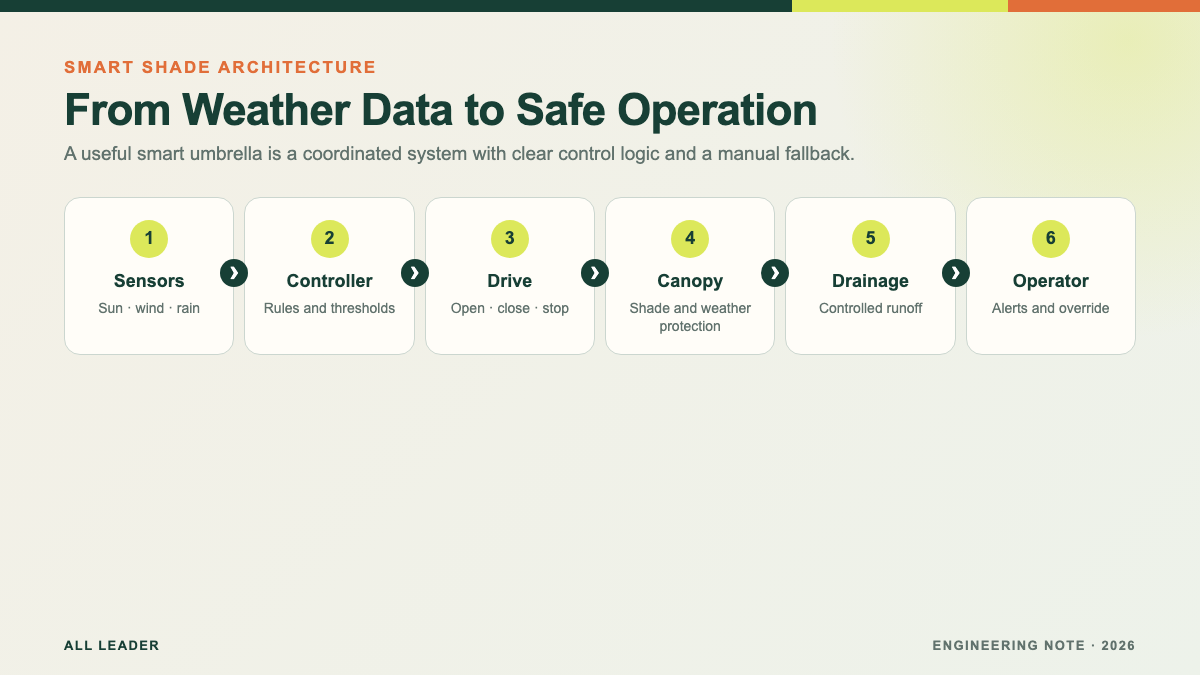
Automation does not remove the need for engineering. The control sequence must define what happens during high wind, power loss, sensor failure, maintenance, and emergency access. Operators also need a safe manual procedure and a clear responsibility matrix.
Public-space applications
Large smart umbrellas can support plazas, schools, parks, transport interchanges, pedestrian crossings, temple forecourts, markets, parking areas, and tourism sites. Their value is highest where shade demand changes through the day or where a fixed pavilion would block circulation, sightlines, or event flexibility.
In a hot climate, shade reduces direct solar exposure and can improve thermal comfort. The actual temperature or energy benefit depends on canopy size, material, solar angle, surrounding surfaces, wind, humidity, and measurement method. Project teams should model or test the site rather than transferring a performance figure from another city.
Designing for sun, wind, and rain
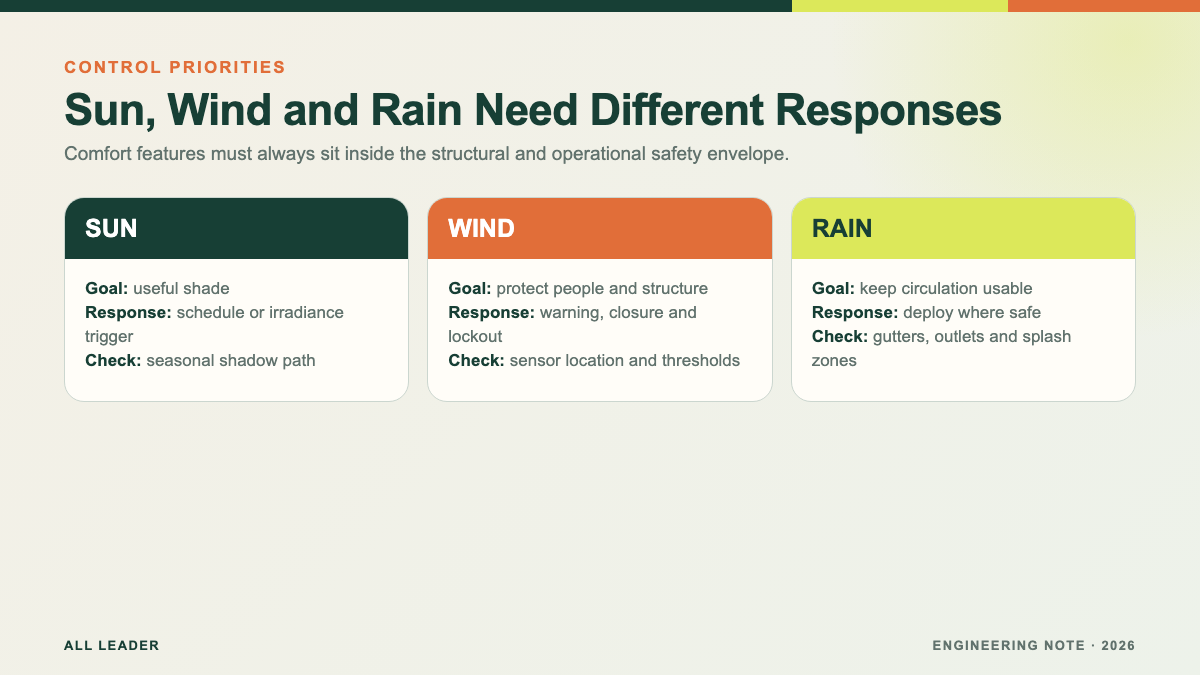
Public infrastructure must address three different weather conditions:
| Condition | System response | Design evidence to request |
|---|---|---|
| Strong sun | Deploy shade while preserving airflow and visibility | shade study, canopy properties, glare and lighting review |
| Rising wind | Warn, retract, or lock into a defined safe state | site wind criteria, structural calculations, control sequence, manual backup |
| Heavy rain | Direct water without creating ponding or unsafe discharge | drainage path, inlet capacity, overflow route, maintenance access |
An inverted or funnel-shaped canopy can direct rainwater toward the central column. International projects such as ThinkPhi’s Ulta Chaata demonstrate rainwater collection and solar integration, while large retractable umbrellas engineered by SL Rasch demonstrate controlled opening and closing at civic scale. These are reference concepts, not specifications that can be copied without local structural and drainage checks.
Why drainage integration matters
Rain concentrated by a large canopy must go somewhere. If the column discharge is not coordinated with underground drainage, a shade structure can move water from the canopy to a new ponding point. The complete path should be traced from canopy surface to gutter or center inlet, through the column, connection, trench, downstream pipe, and safe overflow.
All Leader’s concept uses the canopy and column to direct water into the site drainage system. It is intended to discharge water, not to promise filtration or reuse unless a separate treatment and storage system is designed. This distinction is important for public procurement and maintenance.
Materials and maintainability
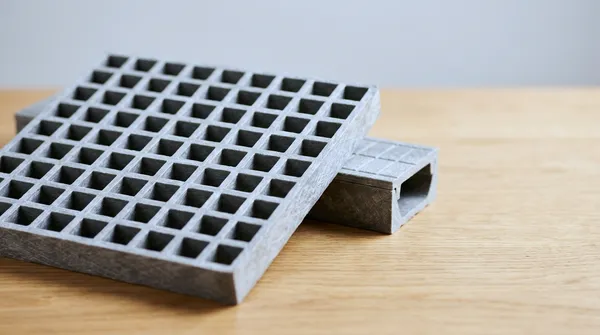
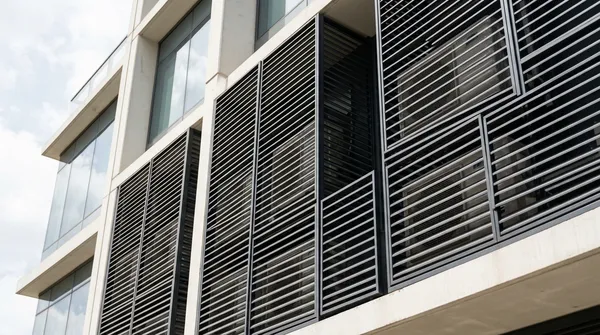
The canopy membrane, primary frame, moving joints, fasteners, electrical enclosure, foundation, and drainage components require different material decisions. PTFE-coated fabric and other architectural membranes may provide long-term weather performance when correctly detailed. Stainless steel or protected structural steel may be appropriate for major load paths. FRP components can reduce corrosion and weight in drainage, access, grating, and customized nonmetallic elements.
Maintainability should be designed before installation. Provide access to motors, sensors, drainage traps, fasteners, and replaceable fabric. Define inspection intervals, post-storm checks, cleaning, lubrication, spare parts, and how the umbrella is isolated safely for service.
Procurement checklist
Before selecting a supplier, ask for a site-specific package covering structural loads, operating wind thresholds, foundation reactions, drainage calculations, controls, cybersecurity or network requirements, emergency operation, installation sequence, commissioning tests, warranty, and preventive maintenance. A working prototype or factory-acceptance test can reduce integration risk.
All Leader offers an integrated smart shade umbrella approach informed by more than 40 years in FRP and drainage systems and more than 200 government-project references. Prefabricated and modular components reduce site work and labor demand, helping public projects control installation time. Our sheltered-workshop model also connects durable infrastructure with inclusive employment.
Frequently asked questions
Are smart shade umbrellas safe in typhoons?
Safety depends on site wind conditions, structure, foundation, control logic, inspection, and the state in which the system is designed to withstand wind. A generic wind-speed claim is not a substitute for project-specific engineering.
Can one operator manage several umbrellas?
Yes, if the control system supports grouped operation, status feedback, alarms, and manual overrides. The operating and emergency procedures should be tested during commissioning.
Do inverted umbrellas harvest rainwater?
They can direct water to a central outlet. Harvesting and reuse require additional filtration, storage, water-quality management, and maintenance; drainage-only systems should be described separately.
Are smart umbrellas a substitute for trees?
No. Trees provide ecological and long-term microclimate benefits. Umbrellas can complement planting where immediate shade, flexible use, clear space, or infrastructure integration is needed.
Sources
- SL Rasch, large convertible umbrella structures: sl-rasch.com
- ThinkPhi founder interview on the Ulta Chaata concept: pv magazine India
- World Health Organization, heat and health: who.int
- International Organization for Standardization: iso.org