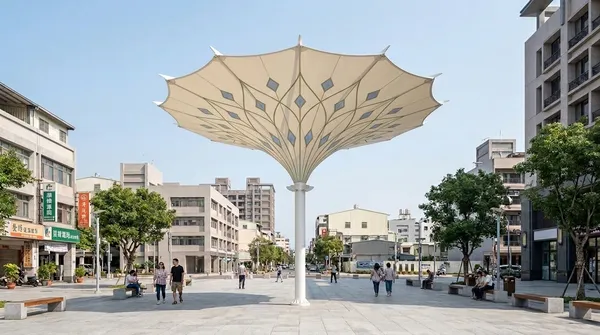
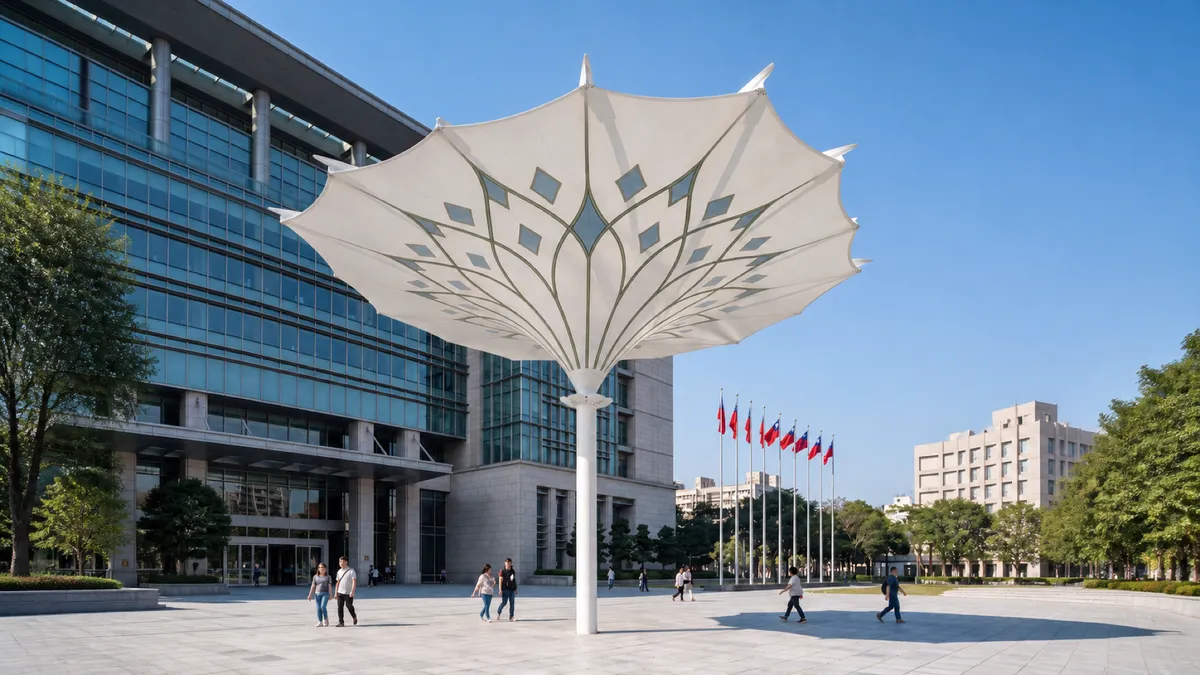
A large outdoor umbrella for public infrastructure is not oversized patio furniture. Once a canopy covers a plaza, school entrance, transit area, market, or civic forecourt, it becomes a structural and operational system exposed to crowds, wind, rain, vandalism, and years of maintenance. Procurement should therefore begin with performance and responsibility—not catalog diameter or unit price.
Choose the infrastructure type first
Large outdoor shade can be delivered as a fixed tensile canopy, retractable umbrella, movable commercial parasol, permanent pavilion, or photovoltaic canopy. Each option solves a different problem.
| Type | Best suited to | Main trade-off |
|---|---|---|
| Commercial parasol | hospitality and flexible seasonal layouts | limited scale and weather envelope |
| Fixed tensile canopy | permanent, wide-area coverage | fixed footprint and more complex foundations |
| Retractable large umbrella | multi-use public space and storm procedures | motors, controls, joints, and maintenance |
| Pavilion | permanent shelter with integrated services | longer construction and less spatial flexibility |
| PV canopy | shade plus electricity generation | electrical integration, glare, drainage, and capital cost |
The right choice depends on how often the space changes, whether emergency or service vehicles need access, the acceptable closure time before a storm, and who will operate and maintain the system.
Six requirements for a public-infrastructure umbrella
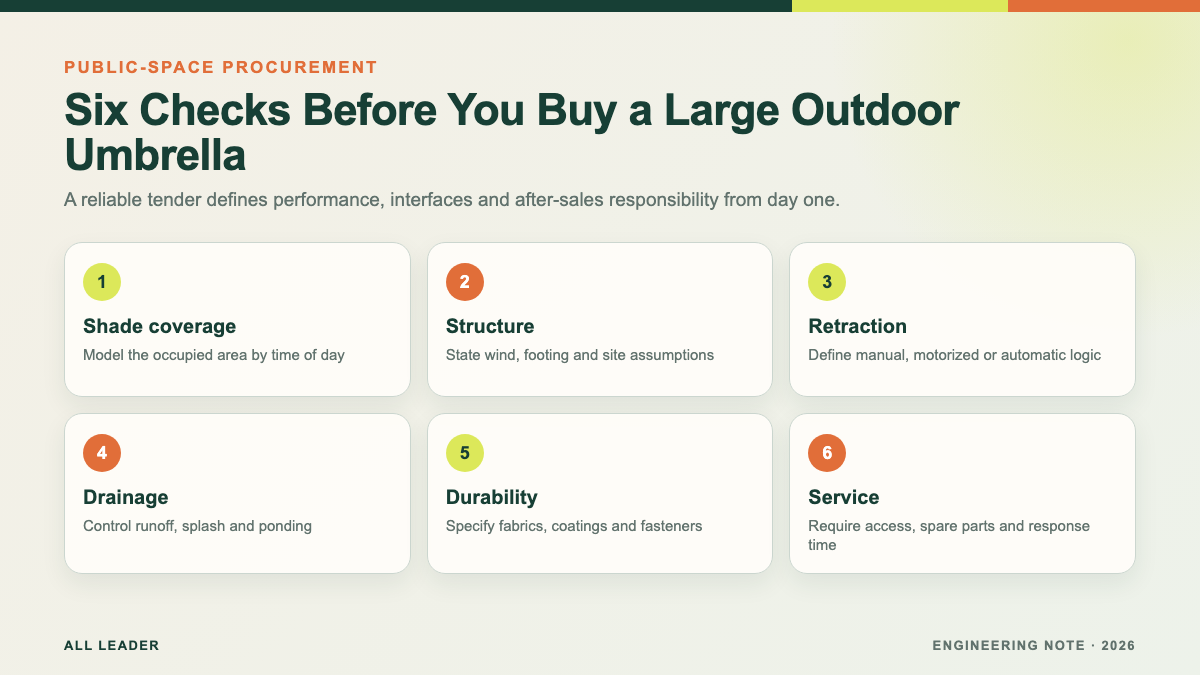
- Shade and comfort: document coverage by season and time of day, not only maximum canopy area.
- Structural safety: define wind, seismic, foundation, impact, and applicable code requirements.
- Retraction and controls: specify operating limits, alarms, manual backup, and safe failure states.
- Rainwater management: show the full drainage route and safe overflow condition.
- Durability: match membranes, coatings, joints, fasteners, and enclosures to UV, salt, humidity, and pollution.
- Life-cycle service: include inspections, cleaning, replacement parts, response time, and end-of-life responsibilities.
These requirements should be measurable in the tender. Phrases such as “typhoon-proof,” “maintenance-free,” or “smart control” need a defined test, calculation, operating condition, and responsible party.
How to evaluate large outdoor umbrella suppliers
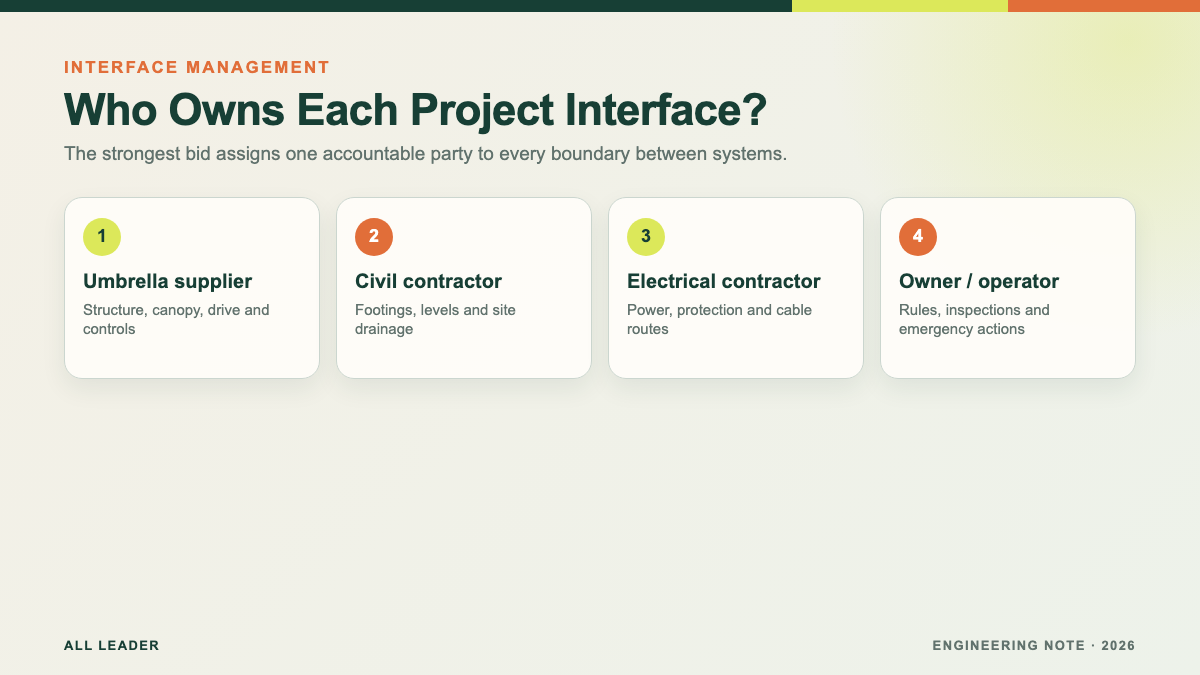
The supplier market includes garden-furniture vendors, membrane specialists, steel fabricators, control-system integrators, and civil-infrastructure contractors. A public project may need several disciplines, but the owner should know who is accountable for each interface.
Ask each bidder to identify responsibility for structural design, foundation, canopy fabrication, motors, controls, drainage, electrical work, installation, commissioning, training, and warranty. Then ask for the interface drawings. Many project failures occur between packages—for example, when the umbrella supplier ends at the base plate and no one has checked the underground drain or cable route.
References should be comparable to the proposed site in scale, exposure, operating mode, and public access. Review test reports and calculations, but also ask how faults were handled, how quickly spare parts arrived, and how the structure was inspected after severe weather.
Wind engineering and operating states
Large canopies create substantial wind forces. Design must consider local wind climate, terrain, nearby buildings, canopy geometry, open and closed configurations, fatigue, and foundation reactions. Retractable systems need clearly defined states such as open, closing, closed, locked, maintenance, and emergency manual operation.
An anemometer alone does not make a system safe. The design should address sensor placement, gust response, communication loss, power failure, conflicting commands, safe access during movement, and what operators do when a fault prevents retraction. Wind resistance figures from another installation should be treated as reference information only until verified for the new site.
Drainage is part of the structure
A canopy gathers rainfall from a much larger area than its column footprint. The design should quantify catchment area, rainfall intensity, inlet capacity, column and pipe size, blockage allowance, underground connection, and overflow. Discharge must not create slip hazards, erosion, or a new flood point.
For an inverted canopy, central collection can simplify the visible edge but makes the internal drainage path critical. Access for cleaning and blockage removal should be included. If rainwater reuse is planned, treatment, storage, water quality, pumps, and separate maintenance requirements must be added; a drainage-only system should not be marketed as a harvesting system.
Installation and long-term cost
Site disruption is a major cost in schools, markets, transport facilities, and busy plazas. Prefabrication and modular assemblies can reduce closures, lifting operations, and dependency on scarce skilled labor. The tender should therefore compare not just product price, but enabling works, traffic management, installation duration, commissioning, routine inspection, energy use, consumables, fabric replacement, corrosion protection, and downtime.
All Leader combines more than 40 years of FRP and drainage experience with over 200 government-project references. Our large smart umbrella system is developed around the complete weather path—from shade and controlled retraction to corrosion-resistant components and site drainage. We provide project-specific planning rather than applying one wind or cooling claim to every location. As a government-registered sheltered workshop, we also integrate inclusive employment into durable public-infrastructure production.
For a tender review, concept layout, or supplier-responsibility matrix, contact All Leader.
Frequently asked questions
What information is needed for a budget estimate?
Provide site location, plan dimensions, desired coverage, operating hours, wind exposure, drainage information, utilities, access constraints, foundation conditions, and required controls. Early estimates should state exclusions and assumptions.
Should a public umbrella retract automatically in high wind?
Automatic response can reduce reliance on manual action, but thresholds, warning time, movement safety, power loss, and manual backup must be engineered and commissioned.
How often should it be inspected?
The manufacturer and engineer should define intervals based on movement cycles and exposure. Inspections are also appropriate after severe weather, impact, unusual noise, drainage blockage, or control faults.
Can a large outdoor umbrella help a green-building project?
It can contribute through shade, reduced surface heat exposure, durable materials, and potentially renewable energy or rainwater systems. Certification credit depends on the applicable rating method and documented project performance.
Sources
- SL Rasch, special and lightweight structures: sl-rasch.com
- International Association for Shell and Spatial Structures: iass-structures.org
- World Health Organization, heat and health: who.int
- CEN-CENELEC, European standards: cencenelec.eu