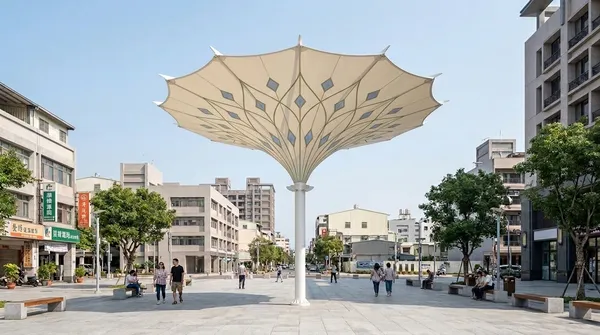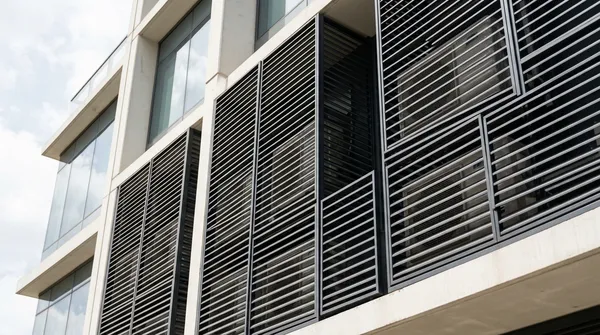
FRP stands for fiber-reinforced plastic, also called fiberglass-reinforced plastic when glass fiber is the reinforcement. It is a composite material: the fibers carry much of the load, while the resin binds the fibers together, transfers stress, and protects them from the environment. This combination allows engineers to tailor strength, corrosion resistance, weight, surface texture, and shape for a specific application.
What is FRP made of?
Most construction-grade FRP combines glass fibers with a thermoset resin such as polyester, vinyl ester, or epoxy. Fillers, pigments, UV stabilizers, and fire-retardant additives may be included when the specification requires them. The exact formulation matters. A product described simply as “FRP” may perform very differently depending on its resin system, fiber content, manufacturing method, and quality control.
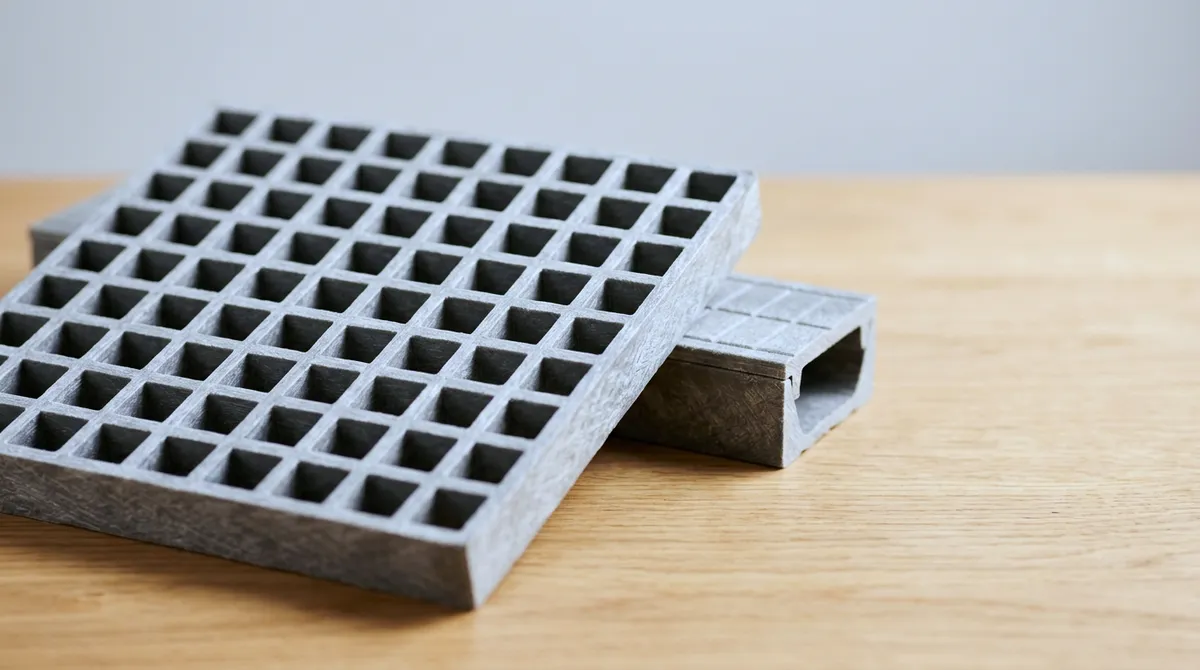
Common manufacturing methods include pultrusion for constant profiles, molding for grating and covers, filament winding for pipes and tanks, and hand or vacuum lay-up for larger custom shapes. Pultruded FRP is pulled continuously through a heated die, making it useful for structural profiles with consistent cross-sections. Molded grating distributes reinforcement in multiple directions and is frequently selected for platforms, walkways, and drainage covers.
Why engineers use FRP
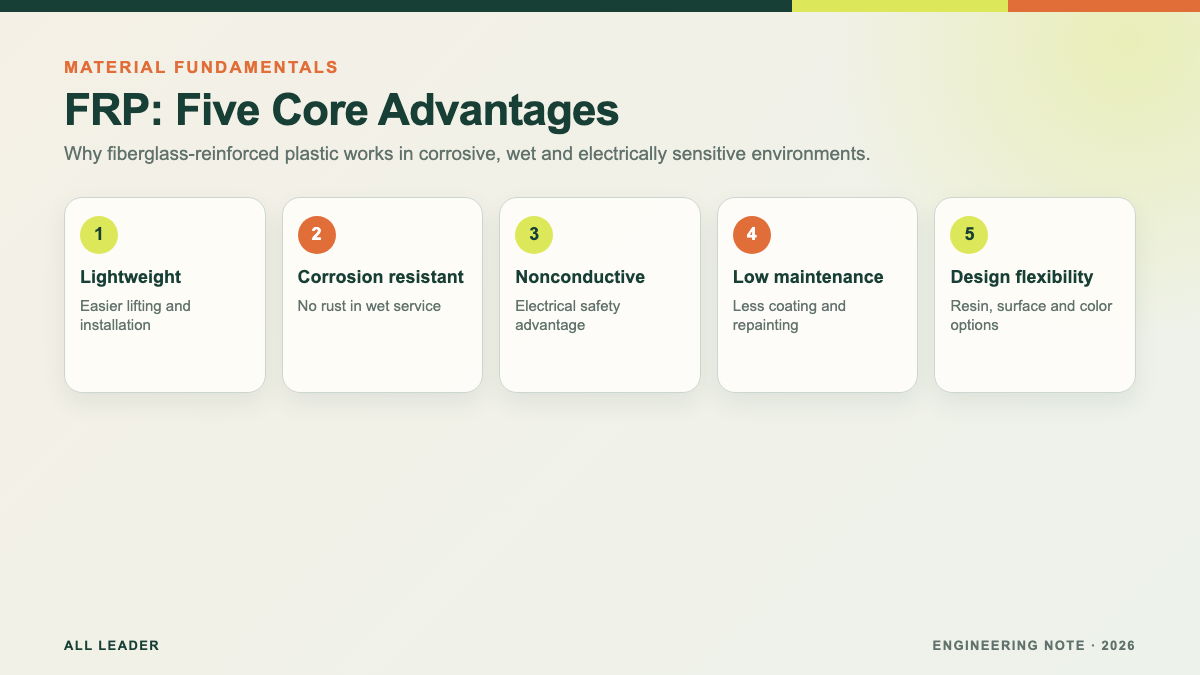
FRP is often considered when corrosion, handling weight, electrical conductivity, or maintenance is a concern. Its main engineering advantages are:
- Corrosion resistance: FRP does not rust like carbon steel. Resin selection must still match the chemicals and service temperature.
- High strength-to-weight ratio: components are lighter to transport and lift, which can reduce site labor and equipment needs.
- Electrical insulation: many standard FRP products are nonconductive, although the final assembly and additives must be checked.
- Design flexibility: color, texture, geometry, and slip-resistant surfaces can be incorporated during manufacture.
- Lower routine maintenance: properly specified FRP usually does not require recurring anti-corrosion painting.
These are material characteristics, not automatic guarantees. Structural capacity, fire performance, UV exposure, deflection, connections, and long-term loading must be verified for each product and project.
FRP compared with steel, aluminum, and concrete
| Decision factor | FRP | Steel | Aluminum | Concrete |
|---|---|---|---|---|
| Corrosion | Does not rust; resin must suit exposure | Coating or stainless grade may be needed | Good in many environments; galvanic corrosion can matter | Reinforcement and cracking require attention |
| Weight | Low | High | Low | Very high |
| Conductivity | Typically nonconductive | Conductive | Conductive | Varies with moisture and reinforcement |
| Field modification | Can be cut and drilled with suitable controls | Familiar fabrication and welding | Familiar fabrication | Heavy cutting and demolition |
| Maintenance | Often low | Coating inspection and repair | Generally low | Crack and surface repair |
| Fire behavior | Must be specified and tested | Noncombustible | Noncombustible | Noncombustible |
The best material depends on the whole system. Steel may be preferable for very high temperatures or compact high-load members. Concrete remains effective for mass and compression. FRP becomes especially attractive in coastal, wet, chemical, or hard-to-maintain locations where corrosion and installation weight drive life-cycle cost.
Where FRP is used
In buildings and infrastructure, common applications include grating, stairs, handrails, platforms, trench covers, drainage components, equipment screens, cable supports, tanks, pipes, and custom landscape elements. FRP grating is widely used around wastewater treatment, food processing, marine facilities, and mechanical equipment because it combines drainage, slip resistance, and corrosion resistance. Learn more about All Leader’s drainage systems and industrial solutions.
How to specify FRP correctly
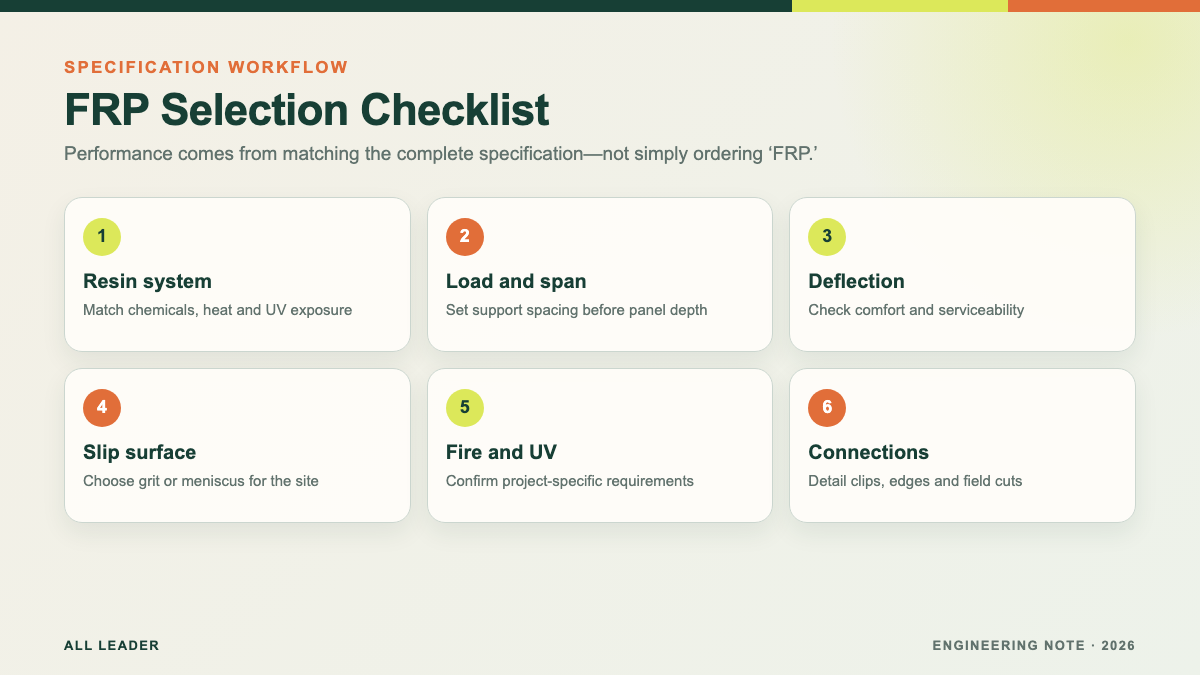
A purchase order should state more than dimensions and color. Ask the supplier to document:
- the resin system and its suitability for the chemical and temperature exposure;
- the manufacturing method and reinforcement orientation;
- design load, clear span, allowable deflection, and safety factors;
- slip resistance and surface type for wet pedestrian areas;
- fire, smoke, UV, and electrical requirements where applicable;
- connection details, edge support, cut-out reinforcement, and installation tolerances;
- test reports, inspection records, warranty, and replacement-part availability.
For grating and covers, the supporting frame is as important as the panel. A strong panel can still fail in service if the bearing width is inadequate, the span is wrong, or clips and anchors are omitted. Final design should be reviewed by the responsible engineer under the project’s local codes and loading conditions.
FRP and sustainability
Durability and light weight can reduce replacement frequency, transport demand, and site disruption. However, FRP should not be presented as automatically “green.” A credible assessment considers resin and fiber production, service life, maintenance, transport, repairability, and end-of-life options. Mechanical recycling, cement-kiln co-processing, and reclaimed-FRP applications are developing, but availability varies by region.
The practical sustainability case is strongest when FRP solves a documented corrosion problem and extends service life. Product-specific environmental data should be used when a project requires life-cycle assessment or green-building documentation.
About All Leader
All Leader International has more than 40 years of experience in FRP composites, over 100 customized product types, and more than 200 government-project references. We support drainage, municipal, industrial, coastal, and custom-building applications from material selection through fabrication and installation coordination. Lightweight prefabricated components can reduce lifting and on-site labor, while modular production helps projects finish faster with more predictable quality. All Leader is also a government-registered sheltered workshop, integrating inclusive employment with long-term manufacturing capability.
For an FRP specification review or custom component, contact All Leader.
Frequently asked questions
Is FRP the same as fiberglass?
Fiberglass commonly refers to glass fibers or products made with them. FRP is the broader engineering term for a resin matrix reinforced with fibers; when glass fiber is used, “fiberglass-reinforced plastic” is accurate.
Does FRP rust?
No. FRP does not rust like steel, but an unsuitable resin, excessive temperature, UV exposure, or poor fabrication can still cause degradation.
Can FRP replace steel in every structure?
No. FRP has different stiffness, fire behavior, connection methods, and failure modes. It should be selected and engineered for the application, not substituted by weight alone.
Is FRP recyclable?
Yes, through several mechanical and thermal routes, but local collection and processing capacity varies. Long service life and correct specification remain central to its environmental value.
Sources
- American Composites Manufacturers Association: acmanet.org
- ASTM International, composite-material standards: astm.org
- CEN-CENELEC, European standards: cencenelec.eu
- International Organization for Standardization: iso.org